


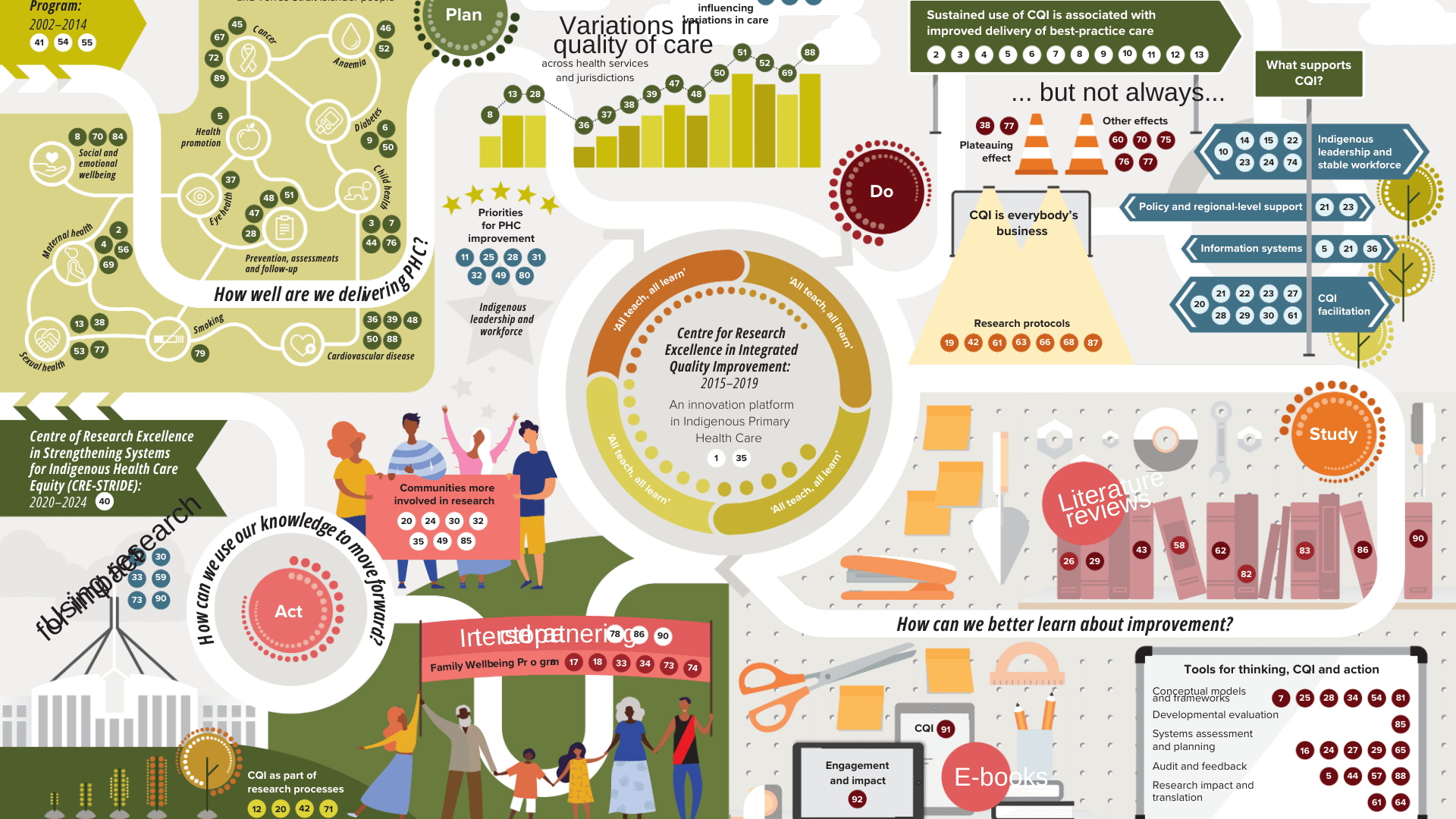
We are proud to be involved in a newly published paper that explores a creative new way to share health research with Aboriginal and Torres Strait Islander communities.
Published in BMC Health Services Research, the paper introduces a tool called a Visual Bibliography. It was developed to make research more meaningful, accessible and useful, particularly in Indigenous health contexts where traditional approaches have often failed to deliver real benefits.
UCRH researchers Alison Laycock, Dr Jodie Bailie and Associate Professor Veronica Matthews contributed to the publication, alongside Professor Ross Bailie, former UCRH Director.
Health research is often shared in ways that overlook Indigenous values, knowledge systems and ways of learning. This can limit impact and reinforce past harms.
This study shows how visual approaches can support better knowledge sharing. Visual storytelling aligns strongly with Indigenous traditions and helps ensure research findings are understood, shared and used.
The Visual Bibliography was created through a large, participatory research collaboration focused on improving Aboriginal and Torres Strait Islander primary health care.
Researchers worked together to bring 92 research outputs into a single visual document using metaphors, infographics and carefully considered imagery. The result is more than a list of publications. It tells the story of the collaboration, its values and how different pieces of research connect.
The process itself also supported shared learning, helping participants see how their work fits into a bigger picture.
The authors believe Visual Bibliographies could be used widely as part of respectful, participatory approaches to knowledge translation. By communicating complexity in an engaging way, they help bridge the gap between research and real‑world impact.
We are proud to see UCRH researchers contributing to innovative, community‑centred research that supports health equity.
