


What counts as research? And who gets to decide what makes research valuable?
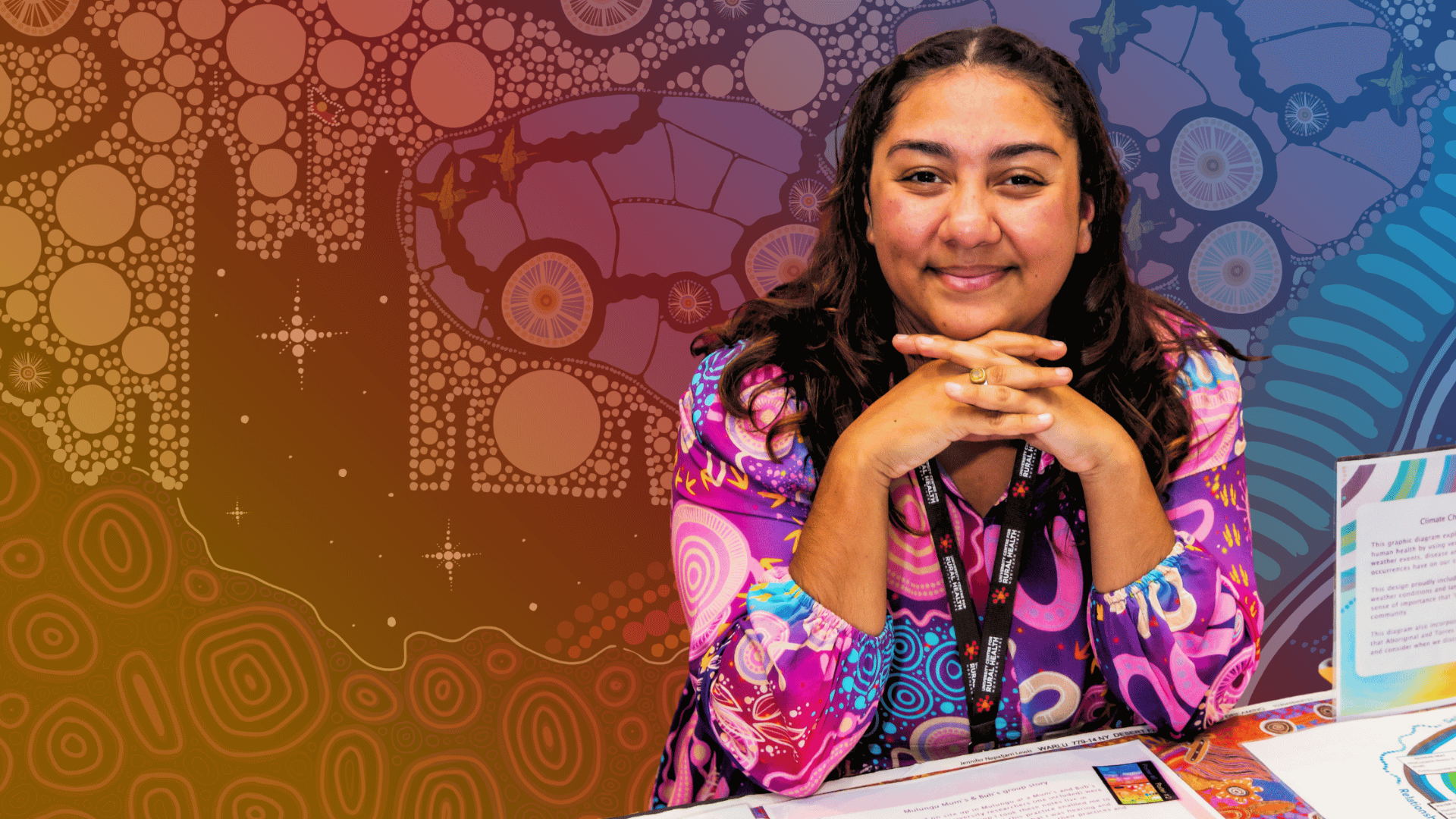
For Gumbaynggirr and Yaegl woman Talah Laurie, those questions sit at the heart of both her PhD and her experience as an emerging researcher at UCRH. Talah is a Research Associate at UCRH and a PhD candidate whose work spans Aboriginal health research, including involvement with the STAUNCH project and WellMob.
Her PhD project, Burrubadi, explores Aboriginal arts-informed non-traditional research outputs and their value within academia. These outputs can take many forms, including art, poetry, dance, music and animation. Talah’s research is exploring how their value and impact can be assessed in ways that are meaningful within Aboriginal and Torres Strait Islander research contexts.
Ultimately, the project aims to develop an evaluation tool, framework and publication journal grounded in cultural knowledge, practices and storytelling, and in the ways Aboriginal and Torres Strait Islander peoples themselves understand and measure success. It is work that challenges some conventional ideas about how research knowledge is created, communicated and valued.
For Talah, that research journey has developed alongside her own journey at UCRH.
Learning goes both ways
Talah came into her first research role without formal qualifications. She has since completed a Graduate Diploma in Indigenous Health Promotion and is now undertaking her PhD. She describes UCRH as a supportive first workplace for an Aboriginal researcher, but says one of the things she values most is the Centre’s willingness to listen, adapt and learn.
“They’ve been an active learning partner with us as well. And it’s taken time to build a nice reciprocal relationship that’s based on a lot of two-way learning.”
That idea of reciprocity runs through the way Talah talks about UCRH. She describes the Centre as a “hub of innovation”, able to adapt to the realities of working in rural and regional communities while creating room for researchers to do work that can make a difference.
Cultural learning has been an important part of that environment.
“It’s been a really safe, happy environment to be working in, and a brilliant first work environment for me as an Aboriginal researcher.”
For UCRH, supporting researchers such as Talah is part of a broader commitment to building research capability in the Northern Rivers. As a collaborative academic hub, the Centre brings researchers, health professionals, students, communities and partners together to develop knowledge grounded in the needs and experiences of rural and regional communities.
Creating trust and opening doors
Talah also sees the research environment at UCRH through the eyes of community. She says Aboriginal community members can be understandably hesitant about universities and whether academic institutions will genuinely value their cultures, priorities and knowledge. Seeing Aboriginal and Torres Strait Islander researchers working alongside people from different backgrounds matters, and for Talah, that visibility can help show community that UCRH is a place they can engage with and contribute to.
Creating opportunities for the next generation is another part of breaking down those barriers, and that’s where initiatives like Baribunmani Wanyi Ngay are critical. Through this program, Aboriginal and Torres Strait Islander high school students visit UCRH and take part in practical activities designed to introduce them to health careers and the university environment.
Talah sees experiences like these as an opportunity for young people to encounter possibilities they may not previously have considered. Her own pathway demonstrates why those opportunities matter. From beginning her research career without formal qualifications to undertaking a PhD exploring new ways of valuing Indigenous research knowledge, Talah’s progression has happened within an environment she describes as supportive of both her academic and cultural development.
Continuing to listen
Asked what she hopes UCRH might achieve in its next 25 years, Talah’s answer comes back to learning. She wants to see more opportunities for training on Country and for UCRH to continue listening to cultural experts and leaders. She also hopes First Nations ways of doing, being and knowing will increasingly translate into practice and policy, influencing not only individual research projects but how institutions work.
It is an ambition reflected in her own research.
Through Burrubadi, Talah is asking academia to think differently about where knowledge can be found, how it can be shared and whose measures of success matter.
And through her experience at UCRH, she has seen what can happen when that learning works in both directions.
“It’s going to be exciting to see how that goes with all of us together.”
