

We’re pleased to share the final report from the Centre for Research Excellence in Strengthening Systems for Indigenous Health Care Equity, known as STRIDE.
STRIDE was a five-year national collaboration (2020–2024) involving researchers, health services, policy organisations and communities working together to improve the quality and equity of primary health care for Aboriginal and Torres Strait Islander peoples. Co-led by UCRH’s Associate Professor Veronica Matthews and Professor Ross Bailie, the project brought together more than a dozen institutions and countless individuals committed to making health systems work better for First Nations communities.
The final report, The CRE-STRIDE Story, captures the breadth of this work – from developmental evaluation and systems thinking, to community-led research and knowledge translation. It shares key findings and messages for action, grounded in the experiences of those working on the ground and those shaping policy and practice.
At its heart, STRIDE was about collaboration. The project built on decades of work in continuous quality improvement, and was shaped by the voices and leadership of Aboriginal and Torres Strait Islander researchers, health professionals and community members. The team embraced an “all teach, all learn” approach, recognising that everyone involved had something to contribute, and something to learn.
STRIDE’s work spanned four interconnected research programs:
- Strengthening community involvement in health system design and delivery
- Building quality improvement capacity across health services
- Supporting social and emotional wellbeing
- Promoting health through prevention and education
Together, these programs aimed to shift the way health systems respond to the needs of First Nations peoples, not just by improving services, but by rethinking how those services are designed, led and evaluated.
The final report includes reflections from STRIDE’s developmental evaluation, which was guided by the Ngaa-bi-nya framework and conducted by a diverse team of researchers. It also highlights the importance of relationality, Indigenous leadership, knowledge sovereignty and reciprocity, values that shaped the project from start to finish.
The STRIDE collaboration also supported a number of focused projects that explored specific aspects of health system improvement. These initiatives were led by diverse teams and grounded in community priorities, and each contributed to the broader STRIDE story. You can read more about some of them here:
- Validating Outcomes by Including Consumer Experience – exploring how community perspectives can shape health service design.
- Women’s Action for Mums and Bubs – a trial of participatory women’s groups to improve Indigenous maternal and child health.
- Working it out together – Aboriginal and Torres Strait Islander-led co-design for a strong and deadly health workforce.
- Health from the grassroots – Consulting community about health and research priorities.
- Healing Country – Weaving knowledge systems to meet climate challenges.
Each of these projects reflects the collaborative, community-informed approach that defined STRIDE. The STRIDE story continues through the NHMRC-funded project Stronger Together As Unified Nations for Community Health (STAUNCH), which commenced in 2025 and will continue to 2029. Through Indigenous Nation-Building and new relational approaches with governments, STAUNCH will support progress towards self-determined health and wellbeing.
We’re proud to have played a role in STRIDE, and we’re grateful to all the partners, collaborators and communities who made it possible. The report is now available online, and we encourage anyone working in First Nations health, rural health or health systems research to explore its findings.
STRIDE was funded by the National Health and Medical Research Council (#1170882) and hosted by UCRH for the University of Sydney.
Read the full report, The CRE-STRIDE Story (2020-2024) here.
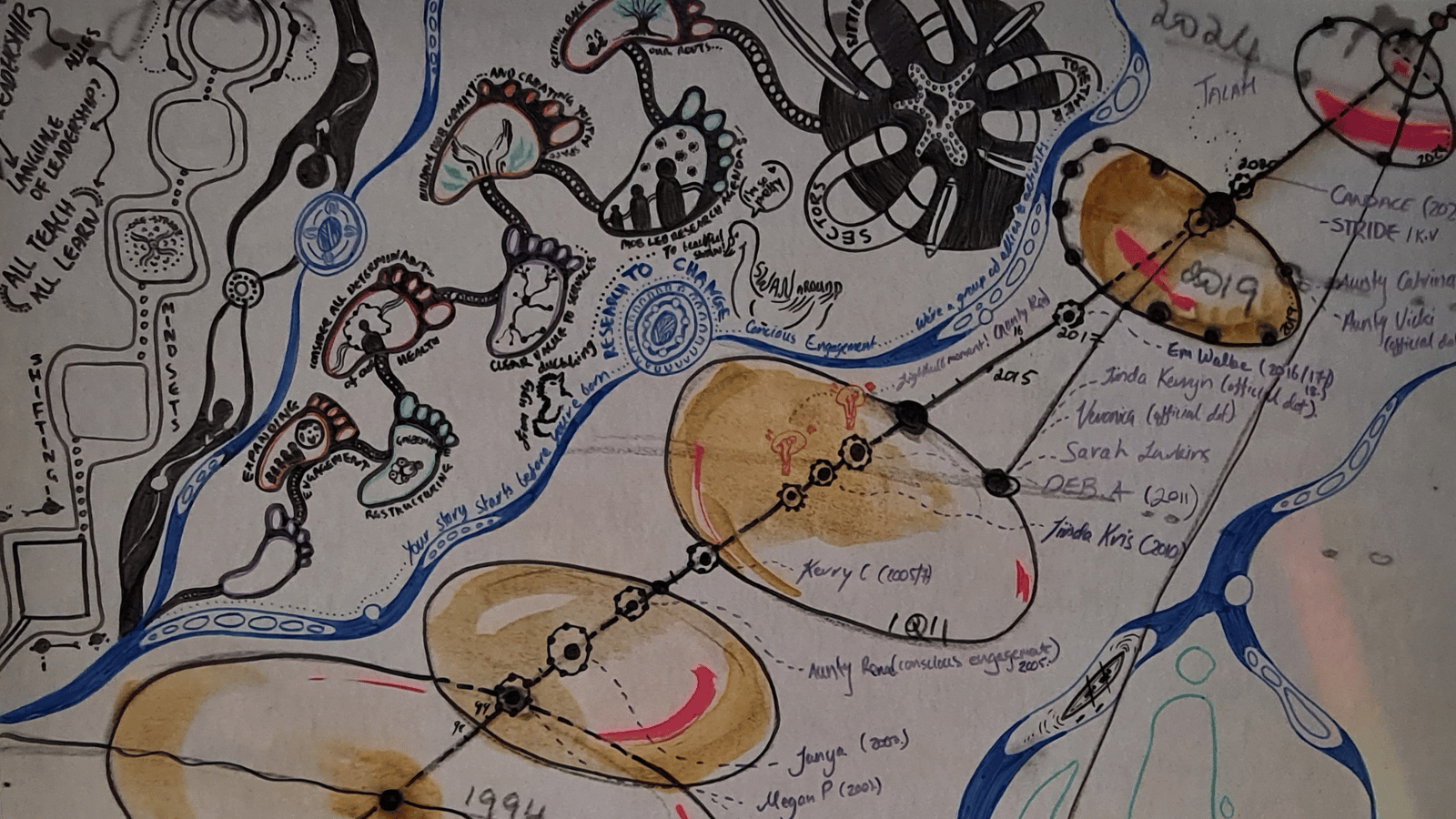
Artwork above, by Vicki Saunders and Talah Laurie, shows a timeline of STRIDE.
Watch a short video below reflecting on the final gathering of STRIDE Investigators, researchers, Aboriginal and Torres Strait Islander Reference Committee members, Seed Project leads and Scholarship awardees which took place in late 2024.
